
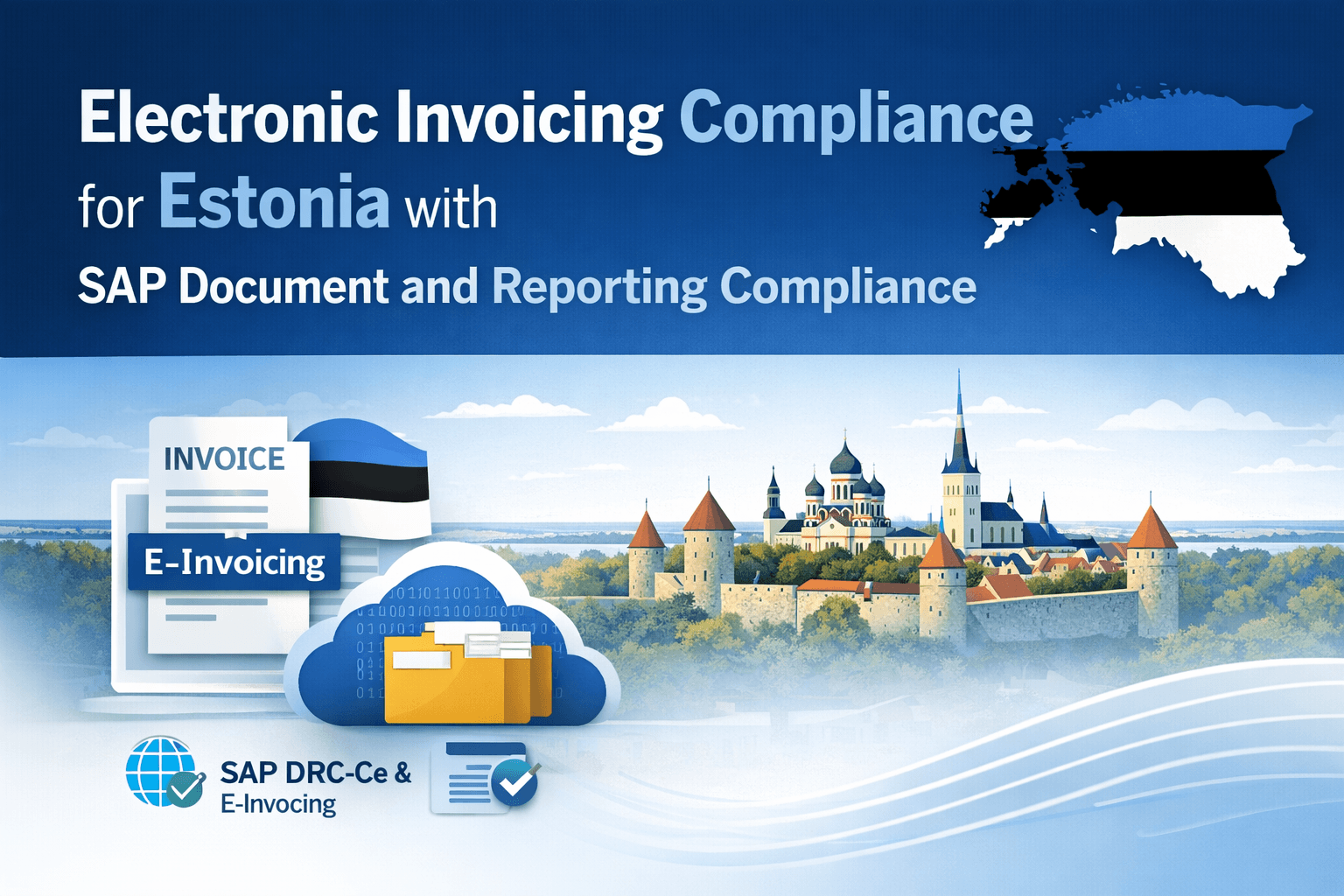
Electronic Invoicing Compliance in Estonia with SAP Document and Reporting Compliance
Estonia is advancing rapidly toward a fully digital, structured approach to invoicing and tax reporting. With mandatory electronic invoicing already in place for public-sector transactions and B2B e-invoicing transitioning from a voluntary system to a mandatory one, Estonia currently stands in a “buyer-choice” phase, with a full mandate expected shortly.
Organisations operating in Estonia must ensure their SAP landscapes are ready for both current and future compliance requirements.
At Crimson Technology Partners, we support organisations in navigating complex regulatory environments through SAP standard, scalable, and future ready solutions. Our Electronic Invoicing Compliance in Estonia solution, built on SAP Document and Reporting Compliance (DRC), Cloud Edition, enables businesses to meet Estonian electronic invoicing mandates with confidence and minimal operational disruption.
Understanding Estonia’s Regulatory Direction
Electronic invoicing has been mandatory for all suppliers to Estonian public sector entities since 2019. Any organization issuing invoices to government bodies must submit structured electronic invoices that comply with accepted standards. This requirement applies regardless of company size or country of establishment, provided the transaction involves an Estonian public authority.
Estonia is moving toward broader adoption of B2B e-Invoicing through a staged approach.
From 1 July 2025, accounting entities registered as e-Invoice recipients in the Estonian Commercial Register will have the legal right to request e-Invoices from their suppliers. When such a request is made, the supplier is required to issue the invoice electronically in a structured format.
In addition, Estonia has announced plans to introduce mandatory B2B e-Invoicing for all businesses by 2027, subject to legislative finalization. This would represent a full transition to structured electronic invoicing for domestic B2B transactions.
At present, B2C transactions are not subject to mandatory e-Invoicing in Estonia. While digital reporting obligations may exist in other forms, structured electronic invoicing is currently focused on B2G and B2B scenarios.
Estonia supports a flexible, decentralized e-Invoicing ecosystem, know also as four-corner model, where businesses may exchange electronic invoices through ERP integrations, certified service providers, or networks such as PEPPOL, using service providers “Access Points”. There is no central national exchange platform. Whilst the preferred standard is the European e-Invoice standard EN 16931, which promotes interoperability across the EU, trading partners may agree on alternative formats where appropriate, and as such, the Estonian national standard (EVS 923) does “co-live” with the European Peppol standard. The legal weight is shifting however heavily toward the European standard. This flexibility places greater responsibility on businesses to ensure their systems can generate, transmit, and receive compliant electronic invoices.
Estonian accounting and VAT legislation requires organizations to:
- Securely store electronic invoices for statutory retention periods
- Ensure invoices remain readable, accessible, and verifiable for audits
- Maintain clear links between invoicing, accounting records, and VAT reporting
These requirements apply equally to electronic and traditional invoices, reinforcing the need for structured and auditable digital processes.
Crimson’s SAP Led Approach
For organizations running SAP S/4HANA or SAP ECC, Estonia’s evolving e-Invoicing requirements introduce both compliance and architectural considerations.
Key implications include:
- The ability to generate structured electronic invoices in compliant formats
- Flexible transmission options to support multiple networks or service providers
- Consistent alignment between billing, accounting, and VAT data
- Robust audit trails and secure electronic archiving
As standard SAP functionality does not fully address all Estonia-specific requirements out of the box, organizations often need partner-delivered solutions to bridge functional and regulatory gaps.
Crimson’s solution extends SAP Document and Reporting Compliance to address Estonia specific requirements while remaining fully aligned with SAP’s standard architecture. It integrates seamlessly with SAP ERP and SAP S/4HANA, enabling secure, auditable, and compliant data exchange without custom developments.
Using SAP’s source document concept, all relevant billing documents from Finance and Sales are consolidated into a single compliance and monitoring framework, supporting B2G, G2G, and future B2B scenarios.
Business Value Delivered
Crimson works with clients to:
- Determine whether e-Invoicing requirements apply based on transaction types and registration status
- Interpret Estonian regulations, including mandatory B2G invoicing, buyer-requested B2B e-Invoicing from 2025, and the planned 2027 mandate
- Define a clear compliance roadmap aligned with business operations
This ensures organizations focus on what is required today while preparing for what is coming next.
Crimson delivers solutions that:
- Enable generation of structured e-Invoices compliant with EN 16931 or agreed formats, according to Estonia’s decentralized transmission model
- Integrate seamlessly with e-Invoicing networks and service providers, including PEPPOL
- Maintain consistency across invoicing, finance, and VAT reporting processes
Crimson’s approach embeds compliance directly into SAP workflows, avoiding fragmented or manual solutions.
Crimson electronic invoicing solutions enable:
- End-to-end traceability between SAP transactions and issued e-Invoices
- Secure electronic archiving aligned with Estonian retention requirements
- Transparent audit trails that support both internal controls and external audits
This reduces compliance risk while improving operational visibility.
Estonia’s e-Invoicing framework reflects its leadership in digital governance and its commitment to efficient, transparent tax administration. With mandatory public sector invoicing already in place, buyer-requested B2B e-Invoicing from 2025, and a full B2B mandate planned for 2027, organizations must take a proactive and structured approach.
For businesses operating in SAP environments, success depends on understanding applicability, preparing systems early, and implementing scalable solutions that align with both national and EU-level requirements.
By partnering with Crimson, organizations can transform e-Invoicing compliance into a controlled, future-ready capability that supports both regulatory assurance and operational efficiency, moving beyond reactive compliance and establish a robust, future proof digital compliance foundation.
Crimson Technology Partners combines deep SAP expertise with regulatory insight to help organisations turn compliance into a controlled, efficient, and strategic capability today and for the years ahead.