
Navigating Excise Duty Complexity with Crimson’s Excise Tax Management
Fri, Mar 27, 2026
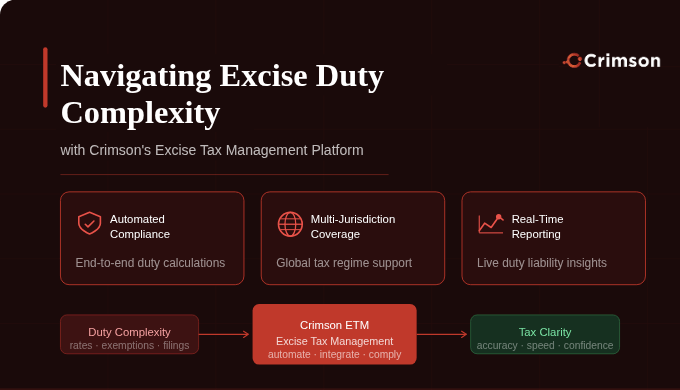
The High Stakes of Excise Duty Worldwide
Excise duties are indirect taxes levied on specific goods—primarily energy products, alcohol, and tobacco—that are considered harmful, luxury, or environmentally impactful. Unlike VAT, excise is product-specific and often quantity-based, generating seven figure numbers annually across only EU Member States, let alone all other worldwide jurisdictions, which have also proven to be creating high impacts in specifically multinational organizations’ supply chain logistics and challenges.
For organizations operating across borders, excise is not just a tax; it is a real-time challenge involving logistics, data integrity, and significant financial risk. Excise tax is one of the most complex and risk-prone areas of indirect taxation globally. Again, unlike VAT/GST, which is generally broad-based and harmonized within regions, excise duties are highly fragmented, product-specific, and often driven by fiscal, environmental, and public health objectives. This creates a wide range of operational, financial, and compliance challenges for multinational businesses.
One of the most significant challenges is the lack of global harmonization. Each country defines excisable goods differently (e.g., fuel, alcohol, tobacco, sugar, plastics, carbon emissions). Tax structures vary widely:
- Specific rates (per liter/kg)
- Ad valorem rates (% of value)
- Product – specific rates (calculation times e.g. ABV, degree Plato and similar).
- Hybrid systems
Frequent legislative changes (e.g., environmental taxes, “sin taxes”) increase volatility. As a result of that, all conscious and built–to–scale businesses must maintain jurisdiction-specific tax logic across dozens of regulatory regimes.
Understanding the EU’s Regulatory Direction
The EU excise framework is governed by a series of directives aimed at harmonizing the internal market while allowing Member States flexibility in setting specific tax rates. Central to this direction is the Excise Movement and Control System (EMCS), a digital backbone that monitors the movement of goods under “duty suspension.”, acting from the reporting perspective and as a kind of merit – based addition or supplement to various local reporting and compliance management requirements.
Also, it is good to mention that the regulatory landscape is shifting toward Extended EMCS, which increases traceability for duty-paid movements and aligns energy taxation with broader EU climate goals. This digital evolution means that manual data entry and disconnected ERP systems are no longer sufficient. Minor data inconsistencies in an electronic Administrative Document (e-AD) can lead to border stoppages, delayed delivery-based penalties, and blocked financial guarantees.
Crimson’s ERP – Led Approach:
While leading one’s business and tax transformation perspectives, the following Crimson’s features may be considered:
- Intelligent Excise Tax Management by Crimson is not only a vivid UI with loads of customization needed from each implementation, but instead, it provides at least 80% built-to-use tax engine.
- By using Crimson’s premium tax content, one is ensuring to have at least the vast majority of the business-wide excise tax complexity scenarios covered from the get-go.
- Crimson’s cutting – edge excise tax solution is done with the clean core principle, meaning there is no code needed nor encouraged within the implementation process. Instead, the whole determination and real – life calculation is cloud–hosted, allowing for a lot of freedom in terms of ERP operational perspective.
- Crimson’s ambition is not yet another expensive consulting services provider, but a fully automated, made-to-shine SaaS provider.
- By choosing Crimson, one gets access not only to the premium tax content and a very savvy determination engine, but above all, the whole intelligence and analytics functions, which altogether bring tax transformation into another level.
Business Value Delivered
- With Crimson, one automatically gets ahead of the curve in at least the following meanings:
- Vast reduction of the excise tax leakage.
- Improvement of the working capital through duty suspension management.
- Mitigation of any potential penalties, which e.g. in the EU itself, may be hiked up to 200% of the non–paid excise duties, but may also very well end up in some criminal accusations for the Boards of Directors and similar bodies.
- By using Crimson’s extensive intelligence and analytics modules, one may not only determine in real – life, but also envisage, foresee and project any potential windfall values, future concerns related to the excise tax and any similar items.
- With Crimson, one gets exposed not only to a fancy tax software tool, but also to the excellent tax advisory team and wholesome of technical, as well as functional ERP experts to make sure one’s tax transformation and transition is seamless and going in the right direction.
- In other words, Crimson does not only want to be the software or services provider, but also – and above all – the organizational extensibility and a trusted partner.